Monday, September 3, 2012

Crabbing the Connecticut River

It had been more than ten years since I last set out to catch blue crabs and I can't really tell you why. Crabbing is such a fun, laid back way of spending time on the water. As a seafood lover, blue crabs are a delicacy that taste all that much better when you catch and cook them yourself. Crabbing is also a great change of pace during the dog days of summer, when surf fishing gets a little tougher due to bath-like water temps. Blue claws thrive in warm water, especially this time of year in the lower Connecticut River. 

There are several methods of capturing blue crabs. When I was younger, my neighbor used to take me at night to marinas in Clinton and Madison, where we would sneak around the docks like ninjas with flashlights, scooping crabs clinging to the pilings with long-handled nets. Other crabbers live by the hand-line method, which is as simple as tying bait (often times raw chicken) to string and slowly pulling in crabs that hang onto their prize for dear life. Another tactic is setting crab traps. The one that I'm most familiar with is a square cage with trap doors that open up once the trap hits bottom. Crabs smell the bait inside, climb on in and when the line is pulled tight, the trap doors close and voilĂ .

During my weekly calls for fishing reports, numerous tackle shop owners have told me  that, as in 2010, this has been a banner year for blue crabs in the tidal rivers of Long Island Sound. I kept telling myself that I was going to capitalize on the opportunity and the time finally came this weekend. Two friends, Blaine of Anderson Guide Service and Andrew of Fishin' Factory III, invited me along on their first crabbing trip in years. The plan was to launch Andrew's Carolina Skiff in Old Saybrook, net some fresh bait, meander up some back channels and trap crabs for a few hours.  

We met at the empty boat launch at 4:30 AM and set out to locate schools of menhaden for bait. The baitfish weren't tightly balled up so obtaining our share took more time than planned. After about an hour, we had what we needed in the cooler through a team effort of Andrew behind the wheel, Blaine tossing the cast net, and myself manning the million-watt flashlight. Along with the adult bunker for crab bait, we also managed a bucket-full of nice sized peanut bunker, which were vacuum-sealed to be used as pike bait for ice fishing season.

A cooler full of fresh bunker to bait our crab traps.

The smaller peanut bunker were kept as pike bait for ice fishing--that's thinking ahead!

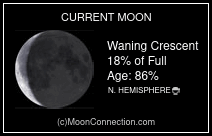
As dawn was breaking, we motored upstream to a spot that we heard had been producing well for a few crabbing regulars. It was low tide on the tail end of a moon phase, so Andrew's high-riding skiff was perfect for the skinny water situation. We readied the traps with fresh-cut bunker chunks, tied them off to empty water bottles as makeshift buoys and set them in a nice line for easy checking every few minutes. By the time our last trap was in, the first we had set had plenty of soak time so we headed back downstream to see if anybody was home. 

The first few checks came up empty and we were about to make a spot move when a trap with two keepers (five inches from spike to spike) came aboard. That was just the boost of confidence we needed to stick it out at our original location. For the next hour, almost every trap check yielded a keeper or three, including some huge, pissed-off ones that you didn't want to put your fingers near! The anticipation while drifting up to our plastic bottle buoys was just like the feeling I get when approaching a tripped flag on a tip-up while ice fishing–you never know what's on the other end. When a trap went cold, we picked it up and moved it to another crabby-looking spot, whether next to a creek mouth or along a set of piling or rocks. 

Many types of baits will work for crabs, but fresh bunker is up at the top.

Blaine setting one of our traps in four feet of water near structure.


Approaching one of our makeshift buoys along a channel bank.


The blue crabs were just part of the allure of the back channels in the lower Connecticut River. Not five minutes from the boat launch, we might as well have been on another planet. The area was teeming with wildlife including fish of all kinds, diamondback terrapins, great blue herons, snowy egrets, dive-bombing osprey, bald eagles, and so many swallows that the sky looked black when they first woke from their roost. We are so lucky to have this wild oasis tucked away in southern Connecticut.

Of course the crabbing was pretty good too. It was never hot and heavy, but we chipped away at a respectable haul over a few hours. When the sun started getting high in the sky, the action in our traps slowed to a halt. We decided to make our way back downstream towards the boat launch and check the wooden dock pilings as we went. This proved to be a wise move and we added another dozen keepers to our total in short order. Blaine and I stood on the bow of the boat as Andrew navigated the tricky currents to put us an arms-length from the docks. Precise net jobs were key with this method and more than once did I botch a chance at a keeper. It didn't take long to recognize that this is a very productive way of crabbing, probably even more so under the cover of darkness.

We ended up back at the now-bustling boat launch at 11 AM with a tally of 57 keeper blue crabs. Andrew graciously gave up his share, so Blaine and I went home with nearly 30 apiece. He brought his home that afternoon to a family get-together, where they steamed and ate them with drawn butter. I steamed my share later that night and enlisted the whole family in the tedious task of picking their meat for soon-to-be delicious crab cakes. The actual act of crabbing is a big part of the whole experience, but coming full circle by cleaning and cooking the catch is right up there. I can say with the utmost assurance that it won't be another ten years before I do this again!  

Crabs weren't the only thing that wandered in our traps; here's a diamondback terrapin.


Watch your fingers around big, angry blue crabs like this one!

We slowly chipped away at a nice haul of delicious blue claws.

These guys sat in the steamer for 30 minutes until bright orange.

Ready for picking and crab cakes.

Editor's note:


At dinner tonight, both sides of the family enjoyed the spoils of yesterday's Connecticut River trip.  Crabbing was serious fun, but don't let anyone tell you that completing the full circle isn't a lot of work. After letting the steamed crabs sit in the fridge over night, we set up a chain gang along the kitchen counter to pick them today. It was a tedious job, but well worth the effort. We had well over two pounds of fresh crab meat when all was said and done. Then my sister-in-law whipped up some serious crab cakes, which we fried on the stove and served with a remoulade sauce. Delicious!!  And to say that I've had a crab renaissance would be an understatement - I can't wait to get out there again.


Here's a video that Blaine put together from our crabbing trip. Enlarge to full screen and switch to HD viewing - enjoy!

\


Wednesday, August 15, 2012

Hawaiian Bones

My wife Mosey and I just returned from the trip of a lifetime to the Hawaiian Islands. We were fortunate to witness a longtime friend marry his true love and we also got to spend 10 days in some of the coolest places on earth. 

The bulk of our stay was on the island of O'ahu. In my research leading up to the trip, I learned this island hosted some lesser known flats teeming with big bonefish. We booked a fantastic guide and had one of the best angling experiences of our lives. If you ever are thinking of going, do yourself a favor and book Mike Hennessy of Hawaii On The Fly--this dude knows his stuff!

If you would like to read more about our Hawaiian bonefish experience, there will be an article coming out in The Fisherman this winter. In the meantime, here is a short video and a couple of photos to give you an idea of how truly amazing the trip was!


Monday, July 30, 2012

Time Of The Season

Family, friends, fishing, fireflies, beach days, Wiffle ball, shish kabobs, steamers, cold beer; these are just a handful of things I look forward to every summer. And, as usual, summer is cruising along at warp speed, so I recommend sitting back and soaking it all in before autumn is at our doorstep. Not that that's necessarily a bad thing; part of the allure of New England is the changing of the seasons and I can rattle of a dozen things I love about fall in short order. 


Nothing screams summer like a delicious bowl of freshly dug steamers.


As far as fishing goes, the story of the summer so far, at least locally, has been bunker; lots and lots of bunker. Many old salts around here say this is the most they've seen in a long time, which is great to hear. Unfortunately, for the most part, striped bass and bluefish haven't got the memo, yet that is, as big pods of the baitfish are milling around Long Island Sound virtually unnoticed by predators. Maybe it's because there are so many bunker schools that bass and blues can pick and choose which ones they want to harass. However, large gator blues are now starting to show up in better numbers and I think that's just what we need to concentrate these various bait schools and jump start the all-you-can-eat bunker buffet. Hopefully they stick around for a while and, barring a mass die-off, we could be in for one interesting fall... 

Dark, nervous patches of water amidst a sea blue are sure signs of schools of menhaden.

The stealthiness of a kayak allows one to more easily sneak up on pods of bait being harassed by bass and blues.
 
A midday striper plucked from underneath a bunker school.
One lazy Sunday in early July, I launched a kayak alone in western Long Island Sound. With zero wind or chop, the Sound looked more like a pond that afternoon, which made it easier spotting the dozens of different bait balls churning the water like butter. I paddled passed a few smaller pods until I saw the mother lode drifting towards me with the incoming tide. Within the middle of this dark patch of water I could hear welcomed signs of predators feeding. Thousands of menhaden rapidly jolting in unison as bluefish slashed through made loud, piercing "WHOOOSH" sounds. It was music to my ears.

I quickly let loose my weighted treble hook into the fray, took one crank of the reel and reared back my rod, instantly snagging an unlucky bunker. With a now-bleeding baitfish doing the work for me, I drifted with the slowly moving school until the unmistakable machine gun tap of a bluefish vibrated through my braided line. I set the hook and was happily treated to a brief Long Island Sound version of a "Nantucket Sleigh Ride," as my kayak was towed by the bulldog of a blue.The rest of the outing was rather anticlimactic with a keeper-sized striped bass fighting like a wet sock in comparison to the yellow-eyed demon. Predominantly a surfcaster, it's always fun for me to get in a yak and access normally hard-to-reach areas or to action that is out of casting range from shore.
Menhaden so densely packed that their yellow forked tails are breaching the water's surface.

Chunking with a fresh bunker head can be the ticket when live-lining is not getting the job done.
The influx of bunker locally has also made for a few good nights of chunking from shore. Not everyone is a fan of waiting for a fish to pick-up a cut piece of bait off bottom, but this isn't your father's way of chunking either. There is no spiking the rod, swilling beers or sitting down; the rod is always held in your hand and every little bump is felt, from spider crabs latching on your offering to a passing bunker brushing your line. When it comes to bait, it pays to be fresh. I'll be the first to admit that I'm a bait snob - if it's not same-day caught and stored on ice, I don't want it on the end of my line. You know when you have fresh bunker because it will retain its slime coat and have a distinct crunch when cut with a knife. The head with an inch or so of meat hanging of the back is the preferred piece; the rest is either used for chum or saved for reserves.

Put a fresh bunker head on your hook and hold on.

My biggest striped bass of the year so far was hooked and lost while chunking one night in the western Sound. Two friends and I went a few hours without a bite before I blurted out "well, tonight's not our night." As soon as the words left my lips, a fish picked-up my head piece and the Baitrunner let out a sound we all love to hear "zzzzzzzzzzzzzzzzzzzzzzzzz!" I engaged the reel and laid back on something heavy on the other end. It took a few slow runs straight out before heading left towards trouble. Looking back, I think I could have horsed her in a little more with the setup I was using, but hindsight is always 20/20. It was dead high tide and the bass went directly over a rocky point that is exposed during low tide. I know exactly what erratic boulder sliced my braid like hot butter and left me wondering how big the fish I lost really was. They didn't all get away. My buddy Jason landed and released some nice stripers over the last few weeks, which was fun to be a part of. 

Jason reaping the results.
Releasing to be caught another night.


If' I'm not using bunker on hot summer nights then it's another form of bait, American eels. I own more artificial lures than I care to count, but it's a rare outing when I don't have an eel, live or dead, on my person. Simply put, our quarry have a hard time resisting them. It's pretty damn cool trapping eels in harbors and tidal creeks, but I also get my kicks off cherry-picking them from local bait shops. They are like slimy confidence in a black bucket. While it's been far from a banner season size-wise for our crew up to this point, most of the decent fish we have taken have come on eels.

This 28-pound bass sucked down an eel on the first cast of the night (Photo credit: Aaron Swanson)
Kurt with a beautiful 33-pounder  (Photo credit: Derrick Kirkpatrick)
A short swim enabled a shot at this late-night bass (Photo credit: Derrick Kirkpatrick).

Derrick releasing another nice eel-caught bass

This 15-pound blue fought nearly as good as it tasted  (Photo credit: Derrick Kirkpatrick)


A nice first-light striper before heading to work.

A rare boat-caught bass from a local reef (Photo credit: Curt Johnson)


As the saying goes, if fishing was just about catching fish, I would have stopped going a long time ago. It's not hard seeing the positive in a fishless outing when we put ourselves in such awesome situations. Whether fishing at daybreak, sundown or in the heart of darkness, there is always something that stops me in my tracks while retrieving a cast and reaffirms my love for this sport and the great outdoors.

Mosey showing off her casting skills on a local sandbar.

A spectacular sunset over Milford harbor.

Monday, July 16, 2012

Far and Away

The title of this post reflects my state of mind when I go to Cuttyhunk just as much as it does the location. The 580-acre rock pile sits an hour ferry ride off the coast of New Bedford, Massachusetts, and is the spear point of the beautiful Elizabeth Islands. Several famous stops along the Striper Coast have their runs of trophy-class fish, but they also come with baggage like overcrowding, traffic and other BS. Not Cuttyhunk; and certainly not in early June...  

The fishing fleet in New Bedford Harbor
On a hazy Thursday morning, a nearly empty ferry dropped our small Connecticut crew off at the main dock on Cuttyhunk with enough gear to appear that we were staying three months, not three nights. Vehicles are scarce on the Island, save for some golf carts and beat-up pickup trucks, so visitors usually travel one way: on foot. Luckily the locals need us as much as we need them and, for a small fee, someone who looked like a member of Z.Z. Top drove most of our gear a half mile uphill to the house we were renting for the weekend.

CT Surfcasters and ZeeBaaS staff watiting for gear to be unloaded at the ferry dock. 
For most of us, there's only one way to travel on Cuttyhunk.

This was my second go around on Cutty, both times visiting as a representative of my fishing club, the Connecticut Surfcasters Association. The Island has a long history surrounding its own, the Cuttyhunk Fishing Club, which was formed in 1865. It included several powerful members among its ranks, like past U.S. Presidents Theodore Roosevelt, William Howard Taft and Grover Cleveland, as well as several business tycoons of their day. The best striper spots around the Island back then were dotted with rickety fishing platforms known as bass stands. Before each of their outings, club members would draw lots to see who fished on which stand, and they all had personal "chummers" that took care of just about everything except reel in the fish, including bait their hooks with fresh lobster. Those days are long gone, yet Cutty's world-class striper fishery remains.

The Cuttyhunk Fishing Club was incorporated in 1865.
This should give you an idea of the caliber of membership in its prime.

Their private liquor lockers still hang on the wall.
Imagine sharing scotch and fish stories with Teddy Roosevelt?

Bass stands dotted Cuttyhunk Island and served as fishing platforms for club members.


Remnants of a reconstructed bass stand below the Cuttyhunk Fishing Club

Gear of Striped-Bass.com members who rented the Club for the weekend.
The history and raw beauty found on Cuttyhunk are more than enough reasons to make the trek, but we were there to do some serious surf fishing as well. Preparations started weeks and months before the trip from triple-checking gear to stocking up on energy drinks and trail mix. When the long weekend finally came, the weather was beautiful and tides were favorable, yet I could have done without the waning full moon.

After settling in the  house, two of our neighbors immediately took off to a cove in snorkeling gear, confident they would find a waterproof camera lost in the surf during a trip three weeks earlier. Honestly, I was surprised when they returned triumphantly two hours later. The camera was shot, already starting to grow barnacles on it, but the real prize, the memory card, was in fine working order. We all got to see the last photograph taken, which captured perfectly the very wave responsible for losing the camera in the first place.

There were also far less exciting things going on during daylight hours, such as catching shuteye, scouting fishing spots, prepping for the nights ahead, and stuffing our faces. The fishing prep included sewing hooks into dead eels and skinning other ones to drape over swimming plugs, essentially creating some of the most lethal weapons of bass destruction on the planet.

The view from our front deck for four days.

 
So many plugs so little time...

Down-time during the day allowed us to enjoy some sun, rig eels and a few beers.

Rigged eels are a proven way of enticing big striped bass.

As darkness approached that first evening, we didn't believe there was a rush to head out early; after all, we planned on staying out past sunrise anyway. That plan would have changed had we known the slow pick of small stripers we experienced would shut off at midnight when the bright moon rose over the horizon. We went hours without another touch until my buddy Kevin scored a 16-pounder on a loaded Redfin and I soon followed with a smaller fish on a Magdarter. Kevin and I made the long walk back to the house in time to have a beer with the sunrise. After a few-hour cat nap, we compared notes with other surfcasters and came up with a game plan for the next night. There was a more consistent bite on the other side of the Island, not big fish, but more fish, so that's where we decided to start night two.
 
A long walk down this dirt road will lead you to some of the finest striper water anywhere
The scenery around Cuttyhunk ain't too shabby.

The obligatory Cuttyhunk striped bass weathervane photo.

Taking what we learned from our first night, we made sure to get started a little earlier the second time around. Our crew split up to hit different parts of the Island and planned to rendezvous later depending on what we found. I was with Kevin again and when we arrived to the water's edge, there was enough light to see a pod of baitfish coming right for us. On my first cast, I zig-zagged a spook across the surface and it was attacked by a tiny bass. It was small bait and, as it turned out, small fish chasing them, but the skunk was off early and we moved around the corner to find a stiff cross breeze kicking up. We waded out towards a nice set of rocks off a point and had to swim the last several yards. A handful of surfcasters made far longer swims than that over the weekend, but ultimately the largest bass came to those standing on or close to Terra firma anyway.

The left to right wind wind made it tricky to stay in touch with live eels, but other than that, our rigged eels and heavier plugs presented no issues. However, the wind eventually began mucking up the water and blowing weed into shore, which was increasingly fouling the hooks on our lures. After a couple hours of peppering the area with casts, all we had to show were a few bumps and a small bluefish. What could be happening on the other side of the Island was eating away at us and we eventually headed in to find greener pastures elsewhere.

Unfortunately, after another grueling walk, we found more of the same; small fish that stopped biting as soon as the bright moon rose and dirty water thanks to the now-stiff southwest breeze. We cut our losses before the sun came up and enjoyed a lightning show in the distance from our deck with some scotch whiskey and cold beer.
 
ZeeBaaS reels ready for battle.


We had the honor of sharing the rocks of Cuttyhunk with legendary surfcaster John Posh.
Here's a look at some of what he was throwing over the weekend.

During our last full day on the Island, we put in a serious shift of scouting the places we'd been fishing under the cover of darkness. Ryan, Mike and I packed light with one rod and lure each, water bottles, and a camera. We would walk until a fishy patch of water caught our eyes, essentially leap-frogging one another while casting along the rocky shoreline. The scouting was extremely valuable to me personally and probably should have been done two days prior. I learned some new rock perches that I would fish during the same tidal stage just 12 hours later. Also, I found it wild how small things looked during daylight that appeared so much bigger or farther away at night!

The daytime fishing was surprisingly good too. The water was gin-clear again and our spooks brought several fish to the surface, including a hefty bluefish for Ryan and a few decent bass that got away. Where I come from it's uncommon to catch fish on plugs from shore in the middle of the day, so it was a pretty cool experience. Mike even stumbled upon a few large menhaden that washed ashore, which was a great sign and would explain the girth on some of the fish he was soon to tangle with.

Typical Cuttyhunk terrain along its south side, a.k.a. striped bass heaven.

A Lordship Lures' spook that has seen a lot of action over the years. It felt right at home on Cutty.

Daytime scouting proves valuable for getting a better look at what rocks you may want to fish from at night.

Ryan with a nice spook-caught bluefish while doing some daytime scouting.
A close-up of the yellow-eyed demon.

Our final night on Cutty started out the best way possible, with a phenomenal feast hosted by our friends from the online fishing community Striped-Bass.com. A large group of them were renting the old fishing club and, since I have been posting on their forum for years, it was nice to finally put faces to Internet handles. The big meal consisted of raw oysters, steamed clams, freshly-caught striped bass and tuna, as well as salad, steak and corn on the cob. After pigging out, various crews went their separate ways to suit up and start fishing. Ryan, Mike and I dropped in below the club and worked our way south with the falling tide, retracing our steps from earlier in the day.

Once in the water, it wasn't long before we learned the fishing had improved since the previous two nights. There seemed to be more striped bass in the area and the ones we found were larger in size. Ryan and I swam out to a nice flat rock for two and Mike found another perch to our right. On a variety of offerings, we all connected with fish bigger than we had found thus far in the trip, including a couple over the 20-pound mark, which was enough to keep morale and confidence high. The good thing about a place like Cuttyhunk is that any cast result in that fish of a lifetime we are all after.

Some of the CT Surfcasters crew before hitting Cutty hard one more night.

A couple hours into the outing, we came upon a cove and saw a headlight on the far end. It turned out being one of our snorkeling neighbors that just released a striped bass over 30-pounds; one of the largest he'd ever caught. Ryan and I joined him and were immediately into fish, mostly on eels-skin plugs. Mike, however, couldn't find a rock to his liking and kept going around the corner to the next cove. Rob, Ryan and I were now into a pretty consistent bite of teen-sized to low-20 pound bass and had no real reason to leave, but had we known what Mike stepped in, we would have ran there. 

As we'd later come to find, Mike experienced an unforgettable hour hooking bass after big bass standing on shore not a few hundred yards from us. On consecutive casts, he landed a handful of high 20-pound class fish, then a 36 and finally 38-pounder. Even crazier is what got away; Mike lost two of what he was sure were bigger stripers after lengthy battles. The two plugs that did all the damage for him, a loaded Red Fin and an eel-skin popper, both had mangled hooks by night's end. We also learned the next morning that another club member went large with a 49-inch striped bass using a Slug-Go on the same side of the Island.  

Mike with a self-timed shot of his obese 38-pound striped bass.

Another look at one of Mike's fatties; note the bent front treble hook from the battle.

For our first two nights, the waters around the Island seemed barren with the occasional small fish. Then, like someone flipped a switch, large striped bass were feeding on big baitfish right at our feet. It was a good feeling to end on a high note, having some of the guys finally catch what we came for, but it was sickening to leave just as we thought we were figuring out a pattern. Over the next couple nights, I texted some of the lucky anglers who planned longer stays and the fishing stayed hot. That's part of the magic of a place like Cutthunk; you can really hit it right sometimes.

It's far from just about the fish though. Thankfully I found multiple bass each night there, but even if I got skunked all weekend, it still would have been worth every penny or second I spent. It was a most memorable trip with a solid bunch of anglers. Cuttyhunk is like Disney World to a surf fisherman and I am already planning my next vacation.