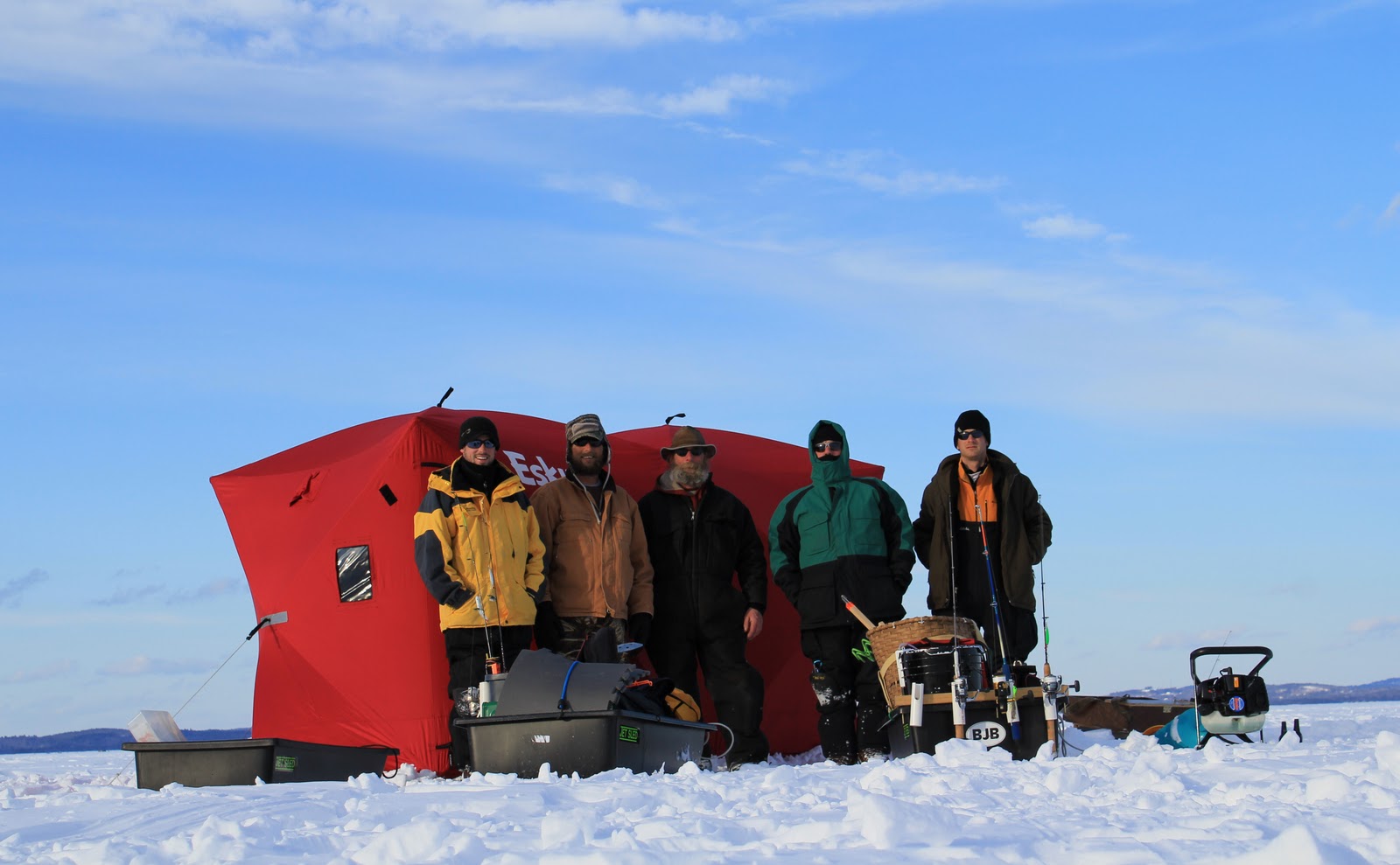
Hopes of ice fishing in Connecticut melted away a few weeks ago, but neighbors farther north are still hanging on to a fading season. Each February for the last several years I have traveled to Maine for the Sebago Lake
Derbyfest, a massive annual ice fishing tournament focused on lake trout. Being the huge body of water it is, Sebago doesn't always cooperate by locking up with ice from shore to shore and you can't have a an ice fishing event with thousands of people involved if the whole lake isn't 100% good to go. Determined to keep this winter tradition alive, I entered annual Maine's Statewide Derby two weeks later. This ice tournament encompasses all lakes and ponds in the Pine Tree State and, in addition to lake trout, has categories for muskie, pike and pickerel.
Last Friday I drove 215 miles to to the home of my good friend Wayne. He used live across the street from my parents before moving north about eight years ago. We would fish together for striped bass, trout and walleye, as well as drink many a Bud heavy in his garage. As crappy as it was to see him leave Connecticut, Wayne fits in well in Maine and it gives me a great excuse to visit each winter. His son and brother also made the trek and rounded out a classic crew for the weekend. The only thing left was to settle was where to fish.
 |
| No toys were spared for the season-ending voyage |
 |
| The annual tax-free pitstop |
All of us wanted a crack at lake trout, or togue as they are widely known in Maine. We don't have them in our lakes back home and they are fun as hell to target through the ice, especially with a jigging rod. With help from electronics, it won't take long to see why many find fishing for lakers addicting; their cat-and-mouse chase game before striking or passing up an offering. It's an exhilarating feeling to have a big mark on your screen rushing up and down the water column after a jig. Sometimes it's a rapid ascent from the bottom that triggers their interest, while other times they prefer a series of gradual rises and pauses. Then there are times where they won't commit or the fish finder resembles a barren desert. In short, jigging for lake trout can be active, challenging and fun all bundled together.
The one and only true trophy lake trout fishery in southern Maine is Sebago Lake. But on the eve of our first day, this vast, deep body of water was 99% ice-free and had full on white caps rolling over where we usually fish. To conjure up game plan, we paid a visit to Greg, the local ice fishing sharpie at the lakeside Jordan's store that I've been dropping by since I was a kid. He let us know about a cove on the other side of the lake had about 6 inches of ice extending one mile from shore. The revelation that we could fish for togue without driving an hour or more to do so was well taken. We bought white suckers and shiners, soaked in more information and set off for a hearty meal of venison that Wayne's brother Roy harvested during Connecticut's black powder season. The thought of an early alarm clock was neglected for a fun night of drinking, darts and tinkering with tackle. No one was in a crazy rush anyway with the weather forecast on tap.
 |
| Last minute tinkering before a weekend on the ice |
 |
| Cold beers, a warm fire, and "Cricket" passed the hours at headquarters |
Rain and ice fishing don't mix well. All it does is create sloppy conditions and make every task harder to do out there. Saturday's forecast called for mixed precipitation at dawn, changing over to all rain through early afternoon. We knew this well in advance, but there's only so much you can do to prepare for it. The one positive thing about the gnarly weather was that it kept crowding to a minimum that first day. Or maybe it was just that no one wanted to fish the only frozen patch of ice on a gigantic lake. There were only a few trucks in the parking lot when we arrived and we set out towards the black dots on the horizon that were anglers already setting up.
It was a good mile walk to the point that Greg told us he found fish near the morning before. Each step punched through the melting layer of snow and slowed our progress. The chosen spot featured shoreline 100 yards to our right, anglers 50 yards to our left and open water 30 yards to our front. Underneath us was a gradual drop off from 30 to 60 feet of water; not a bad ambush spot for lake trout, on paper at least. We set up the trusty, yet aging shelter right off the bat. Without it the day would have ended hours sooner than it did. It leaked like a sieve at the seams, but when the sky opened up we were all happy to have it. Next everyone got to work. Dozens of holes were drilled, tip-ups were set and jigs were dropped to the bottom. I focused on a long line of holes along the drop off and began mobile jigging, setting a few baited traps as I went.
After a couple hours of no flags going off and staring at a blank screen in the rain, I headed for the shelter, drilled one more hole and made my last stand. The two "waterproof" outer shells I brought only held up for so long; I was wet to the bone. The temperature was above freezing, but the damp cold was taking its toll. Morale was spiraling downward before Wayne shouted in the distance. He was setting his last trap a little closer to shore and must have dropped his baitfish right on the head of a hungry lake trout. As soon as he put the tip-up on the ice, its flag tripped and nearly whacked him in the face. Wayne won the brief tug of war and a flopping 24.5-inch lake trout was on the ice and we were on the board. I couldn't have thought of a better shot in the arm for our group than that first togue.
 |
| Wayne from Maine showed us how it's done on Sebago Lake. |
 |
| Great coloration on the fins of this 4-plus pounder. |
With a renewed sense of hope, we all got back to work after devouring bacon, egg and cheese sandwiches cooked the only way they could have, on a Coleman stove inside the shelter. The forecast called for sunshine after the rain moved out, so I occasionally glanced at a radar app on my phone with hopes that the yellow and green mess on the screen would pass quicker. During a check in one particularly heavy downpour, a text message from an ice fishing friend flashed across the screen: "Jig 'em up!" No sooner did the phone go back in a dry sack did the first black mark rise off the bottom on my fish finder. I cranked the reel handle a few turns and the dance began. The fish followed my chartreuse bucktail jig tipped with a white sucker fillet, but quickly lost interest and headed back down toward bottom. I flipped the bail and dropped the jig below him and, like he saw it for the first time, the togue followed the bucktail up a few feet before again losing interest. However, the fate of this dance number was already sealed. After a few more rises and falls, the fish couldn't resist and inhaled the jig 35 feet below the ice. The pool cue of a rod made short work of the smallish trout. For me, it was more about the how, the where, and the when that I was psyched about. I jigged up a togue from Sebago Lake in March!
 |
| The one and only lake trout I caught on Saturday |
 |
| This trout liked the custom made bucktail jig I bought at Jordan's general store a few years ago |
The two lake trout we caught on Saturday were hard earned. Our comfort level on a one to 10 scale was hovering near zero. The rain and slush had cut down our angling effort, but it was obvious by the lack of activity seen that it just wasn't happening. The decision to cut our losses and dry out for day two was an easy one. The prospect of beer and whisky next to a stoked wood stove was hard to pass up. We packed up our wet and now heavier gear and made the long trek back to the lot. Of course by the time we got there, the sun was finally breaking through the clouds.
Just by entering lake trout in the Derby, regardless of size, gives anglers a chance to win prizes. So on the drive back we stopped by an official weigh station, which was a convenience store that had a Derby official at a counter with a measuring board and scale. At the time, Wayne's 4.36-pounder was the second place lake trout in the contest, but, as expected, heavier fish came in through the afternoon and the following day. It was still fun being in the running even if only for a short time. Next we stopped at another bait shop for live smelt at $7 per dozen. These smelt were small, maybe 3 inches long, but were the exact forage Sebago's lakers predominantly feed on. The two dozen we bought would turn out to best money spent all weekend.
Back at the homestead, Wayne's man cave was turned into a giant clothes line. A bunch of drinks and laughs followed another great meal, especially noteworthy because it was the first time I've ever eaten lake trout. Wayne prepared "Togue chowda" and faked the thick Boston accent every time he said it. It was excellent and put to rest any misconceptions I've read online about lakers tasting so bad a cat would turn it down. Wayne's brother in-law, one of my childhood friends, stopped over and it was awesome catching up over a beer. Wayne also broke out his father's Native American artifact collection, which got plenty of "oohs" and "ahhs" as the ancient stone tools were passed around the room. Quitting time was after midnight and the alarm clock came fast once again, but Sunday would offer a welcomed change of pace in both weather and action.
 |
| Drying out in the man cave |
 |
| "Togue Chowda" was surprisingly and utterly awesome |
 |
Wayne shared part of his father's Native American artifact collection.
These quartz projectile points were found in Connecticut farm fields. |
The plan of attack on Sunday was to head back to the same general area and take what we learned and hope some sort of bite materialized. Surprisingly, even though the weather improved immensely, less anglers were set up on the slowly shrinking cove of ice. The temperatures dipped enough over night to freeze the slush on the ice to aid our mile walk out. Fishermen were already occupying the holes we drilled Saturday, so we pushed closer to the open water and away from the 10 or so others on the cove. There was a light south wind creating a chop and pushing water on to the ice, slowly eating it away. Even though what we were standing on was strong enough to support snow mobiles, the sound of open water so close was a little eerie at times.
Without the rain bogging us down, everything was easier to do. We set up the shelter, but more to dry it out as we never stepped foot in it being so comfortable out. A few more traps were put in the water on Sunday too, increasing our odds of finding some action. It didn't take long to notice there was more going on below us than the day before in regards to activity. Our fish finder screens displayed more life right away and that's where the live smelt came into play. On Sunday's jigging mission I drilled another long line of holes, but this time in pairs of two. In one hole I would drop down a jig like a classic white tube, an airplane jig, a Swedish Pimple, or the bucktail that produced the day prior. In the other hole I had a gold willow leaf hook tipped with a live smelt; the theory was the smelt would impart action to the willow leaf, which would put off gold flash and draw in passing fish. So I jigged aggressively to call in fish from the surrounding area. When one came in for a look yet wouldn't chase, then sent down the more subtle and natural offering, the live smelt. This one-two punch worked on a few different occasions Sunday, but the first time I won't soon forget.
When a lake trout struck my smelt in 55 feet of water, I set the hook and connected on what felt like an ordinary fish. However, as I horsed it off bottom, my rod tip doubled over and it was apparent this was something heavy. I called over the boys to clear the hole of ice and help grab the fish when it was ready. I had a great feeling for a couple minutes until I looked over to my jigging rod in the other hole and noticed its bail open and line peeling out. This 22-inch fish wrapped itself around my other line and gave the appearance and feeling of a 10-pound trout. Talk about a let down! I went from thinking I had a tournament-winning fish on to learning my lesson of not having both lines down at the same time so close together. At least we were catching, right?
 |
| The 22-inch "10-pound" lake trout and a light jigging rod next to it |
 |
| A close up of the gold willow leaf hook in the laker's mouth |
In the three hours that followed I witnessed my most active period of lake trout activity yet. All four of us were marking targets and getting them to chase. A few different jigs were garnering interest and even our baited tip-ups received a little play. One of my filleted five-inch suckers lying on bottom was picked up and dropped after a 20 yard run as I was busy dealing with a fish on the jigging rod. Wayne landed another fish on a trap that took a live smelt in about 60-feet of water. Both Roy and Wayne jigged up togue using bucktails tipped with smelt. I also experimented and had success with Gulp smelt, soft-plastic minnows soaked in a stinky concoction. All the fish were in that same lower 20-inch size class, but it was consistent action and loads of fun. If the lake had more ice, we could have ventured to deeper water or to a spot better known for bigger lake trout, though we were glad just to be on Sebago at all. The chance for a trophy is ever present there no matter where you are on the lake.


The morning bite slowly tapered off around lunch time and eventually the flags and fish finders shut down completely. Another form of entertainment picked up, however, in the form of a family of four bald eagles eating leftover baitfsh on the ice. Two adults and two sub-adults were hanging around us for a while calling to one another and keeping watch for easy meals. Seeing the national bird is a sight that will always stop me in my tracks as it did that day; just awe-inspiring animals, I only wish I had a zoom lens for my camera!


With the four-plus hour drive home looming and work coming early on Monday, it was time to pack up and say goodbye to Sebago and good friends once again. I'm so glad I pulled the trigger on this final ice trip of the season. If nothing else it leaves me with another positive memory of the weakest year of ice fishing that I've ever known. As always, it was great to see Wayne, Roy and Sean. The two days on the ice left us with valuable experience. The crew gained important confidence in a few jigs, baits and techniques. We learned a part of the lake we had never been before. We toughed out some horrible conditions and were rewarded with a banner morning because of it. The most important thing was that we had a hell of a weekend and are already looking forward to next year. Now it it's up to Old Man Winter to hold up his end bargain and have all of Sebago Lake frozen and fishable next year!
 |
| The 2012 Sebago crew (beard mandatory) |
 |
| The ice sled in all her glory |
 |
| Happy trails! |


 The rivers we fished in western Maine (and the large lakes
that feed them) harbor the last of an incredible strain of brook trout. These fish were recognized by turn of the
century sportsman to be worth saving. Thanks to foresight and conservation,
there are still a handful of waters where trophy quality brook trout can be
found stateside. Combining tips and assistance from one of the area’s top
guides with fortuitous timing and find them we did.
The rivers we fished in western Maine (and the large lakes
that feed them) harbor the last of an incredible strain of brook trout. These fish were recognized by turn of the
century sportsman to be worth saving. Thanks to foresight and conservation,
there are still a handful of waters where trophy quality brook trout can be
found stateside. Combining tips and assistance from one of the area’s top
guides with fortuitous timing and find them we did.